
Everyone is talking about AI that runs your business on autopilot. For a small business, that is the wrong question. The right one is simpler: if this task goes wrong, how bad is it? The answer tells you whether AI should do it alone, do it and wait for your OK, only prepare it, or not touch it at all.
One question: how bad is a mistake?
At SEONGON's AI-First Talk 02 on running AI agents in a marketing department (30 September 2026), Mai Xuân Đạt sorted 45 everyday marketing tasks by one question: what happens if the machine gets it wrong? Each task lands on one of four levels, cross-checked against the O*NET occupational task database. His count: 27 of the 45 tasks sit on the first two levels, where a machine can do the work and a person checks it. The rest still need a person in charge.
We like this framework because it replaces a vague debate about trusting AI with a concrete test you can apply to any task, in any business.
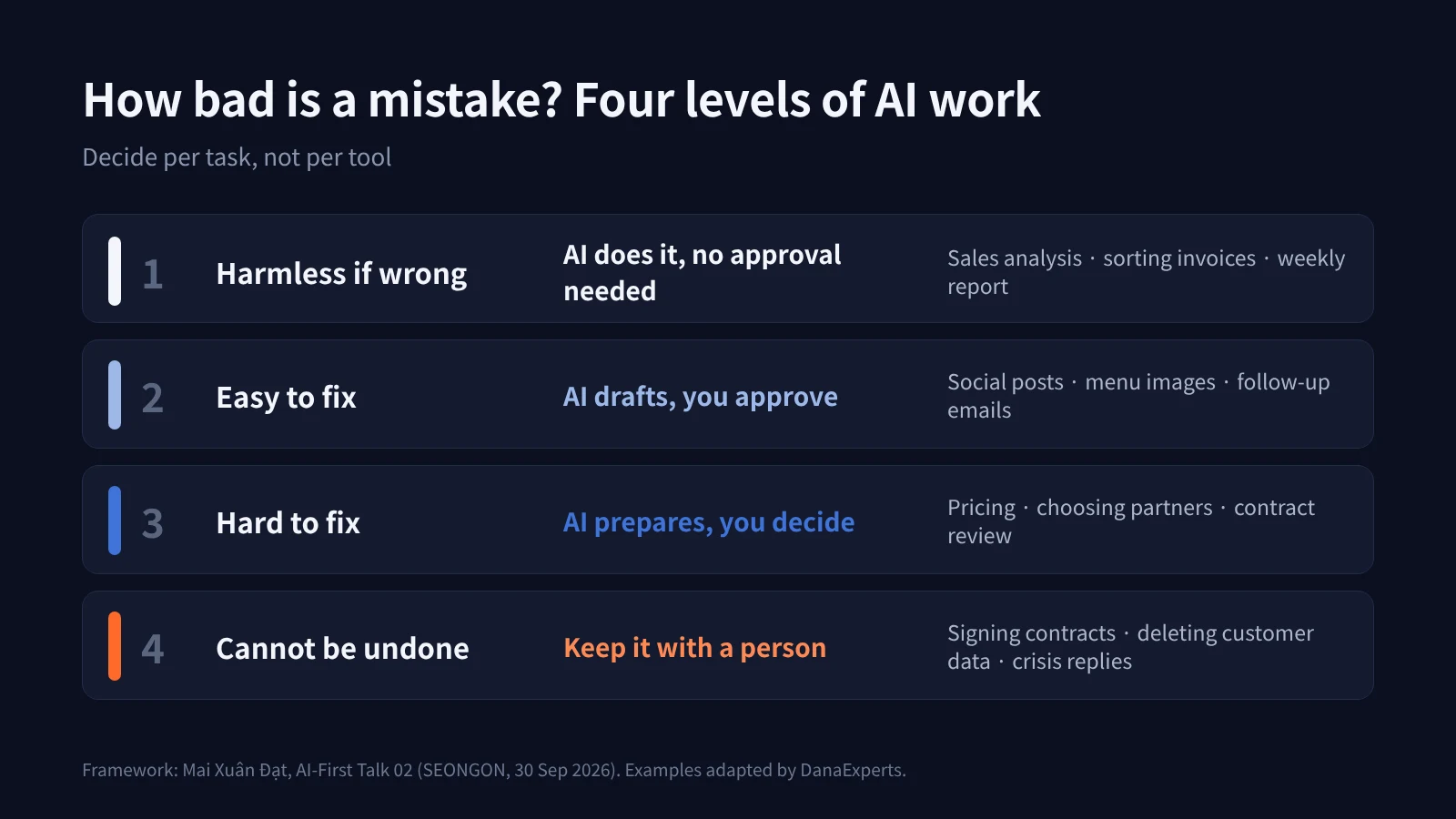
Level 1: a mistake does not matter. Let AI do it.
If the result is wrong, nobody outside your business notices and you lose a few minutes. Analysing last month's sales by customer group, sorting supplier invoices, drafting a weekly report, tracking competitors' public prices. Let AI do these without asking, and read the result when you need it.
Level 2: a mistake is easy to fix. AI does it, you approve.
A social post with a typo, an email draft in the wrong tone, a menu image with last week's price. If it slips out you can correct it, but it is your name on it. This is where most daily marketing and sales work sits, and where an approval step costs you seconds and protects your reputation.
Level 3: a mistake is hard to fix. AI prepares, you decide.
Setting prices, choosing a partner or agency, reviewing a contract, publishing anything with legal or health claims. AI can do the groundwork: compare options, flag risky clauses, draft the brief. The decision and the final wording stay with a person who knows the context.
Level 4: a mistake cannot be undone. Keep it with a person.
Signing a contract, deleting customer data, announcing a new price on every channel at once, emailing your entire customer list, launching a large ad budget, answering the press in a crisis. Once done, they cannot be taken back. Here AI should not act at all, however good the draft looks.
How BeeStaff.ai puts the four levels into practice
BeeStaff.ai is the AI team DanaExperts built for small businesses, and we run our own sales and marketing on it every day. Its rules follow the same logic.
- Work that sends nothing, such as research, reading invoices or a sales report, is simply done and recorded in the activity log, so you can check it whenever you want.
- Anything that is published or sent arrives as a draft first. You approve it, change it or bin it, on your phone or in your browser. If you do nothing, nothing goes out.
- Social posts are always published only after approval. The publishing step refuses anything not marked Approved, and each approved version is posted only once.
- For sales steps, such as a follow-up to someone who asked for a quote, you can switch a single step from Ask me first to Automatic once its record has earned your trust, and switch it back at any time.
- Leon reads contracts and flags risky clauses with page numbers, but you decide. Nora and Leon support your accountant and lawyer; they do not replace them.
- You set a monthly cost limit. When it is reached, work pauses until you decide to raise it.
Checked before it reaches you
Before a draft lands on your phone, it is checked for tone, spelling, prices and facts against what you have told your team about your business. A draft that fails the check goes back to be fixed instead of waiting in your queue. That keeps level 2 fast: you approve work that is already close to ready.
Start careful, then move tasks down a level
Trust is earned, by AI employees as much as by new staff. Start with everything on Ask me first. After a few weeks, look at which tasks never needed a correction and consider letting those run on their own. Leave level 3 and 4 tasks with people.
BeeStaff.ai can be tried free for 30 days on your own business while it is in its test phase, with a monthly cost limit you set and no contract. For workflows that depend on your own systems, DanaExperts can build a custom two-week pilot.